


Two years ago, when we last surveyed Norwest’s portfolio companies, the workplace was still finding its footing. Mental health benefits were expanding fast, return-to-office debates dominated every leadership meeting, and companies were scrambling to stand out in an incredibly competitive talent market.
Looking at this year’s results, it’s fascinating to see that not much has changed — only that AI adoption has accelerated the trends we were already seeing unfold. This July, we surveyed talent leaders across 113 portfolio companies, and the data tells a clear story: we’re past the AI experimentation phase. Companies are starting to integrate AI into how they work and looking for ways to gain greater efficiencies.
AI Is No Longer Coming. It’s Here.
In the survey, 76% of companies report using AI, citing productivity and time savings as key drivers. Engineering and IT teams emerge as leading adopters of AI, 86% have built it into their regular workflows. On tech teams predominantly, we’ve moved beyond pilot programs; AI coding tools have become embedded in every day workstreams.
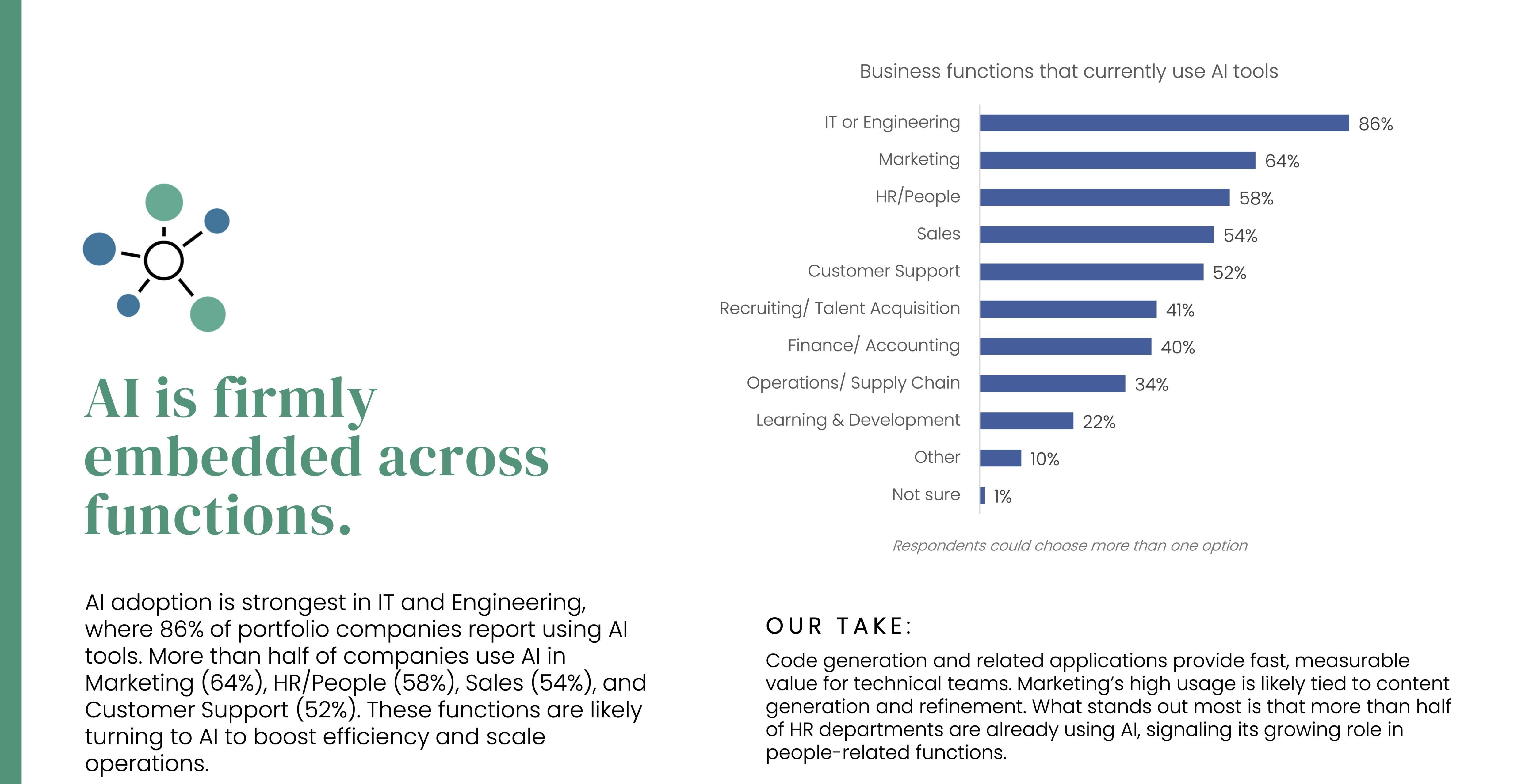
But what surprised us is how AI has spread beyond engineering. The grassroots adoption we’re seeing is different from how companies usually roll out new technologies.
The Grassroots Revolution
When AI first exploded onto the scene, everyone assumed companies would need to follow the usual playbook for company transformation: hire a Chief Officer or consultant, build an enterprise-wide strategy, roll out approved tools from the top down. That’s not what happened.
“When AI first exploded onto the scene, everyone assumed companies would need to follow the usual playbook, but that’s not what happened.”
With extremely low barriers along the learning onramp, teams and individual contributors started experimenting with AI on their own. They found what worked and shared wins with colleagues. HR teams built entire compensation frameworks in a day instead of a month. Sales teams built custom agents to handle lead qualification. Marketing teams automated content creation to accelerate and scale their go-to-market.
This bottom-up adoption means AI is spreading faster, but also less evenly, perhaps even less intentionally. Some companies have pockets of use everywhere and AI Hackathons hosted by teams from Marketing to HR to engineering. Others are slow out of the gate, looking to leadership teams to dictate where to start. One difference in the speed and approach to transformation (that we all know is coming) is trust. The companies with cultures where people feel safe trying new things, learning out loud, and sometimes failing, are the ones moving fastest on AI.
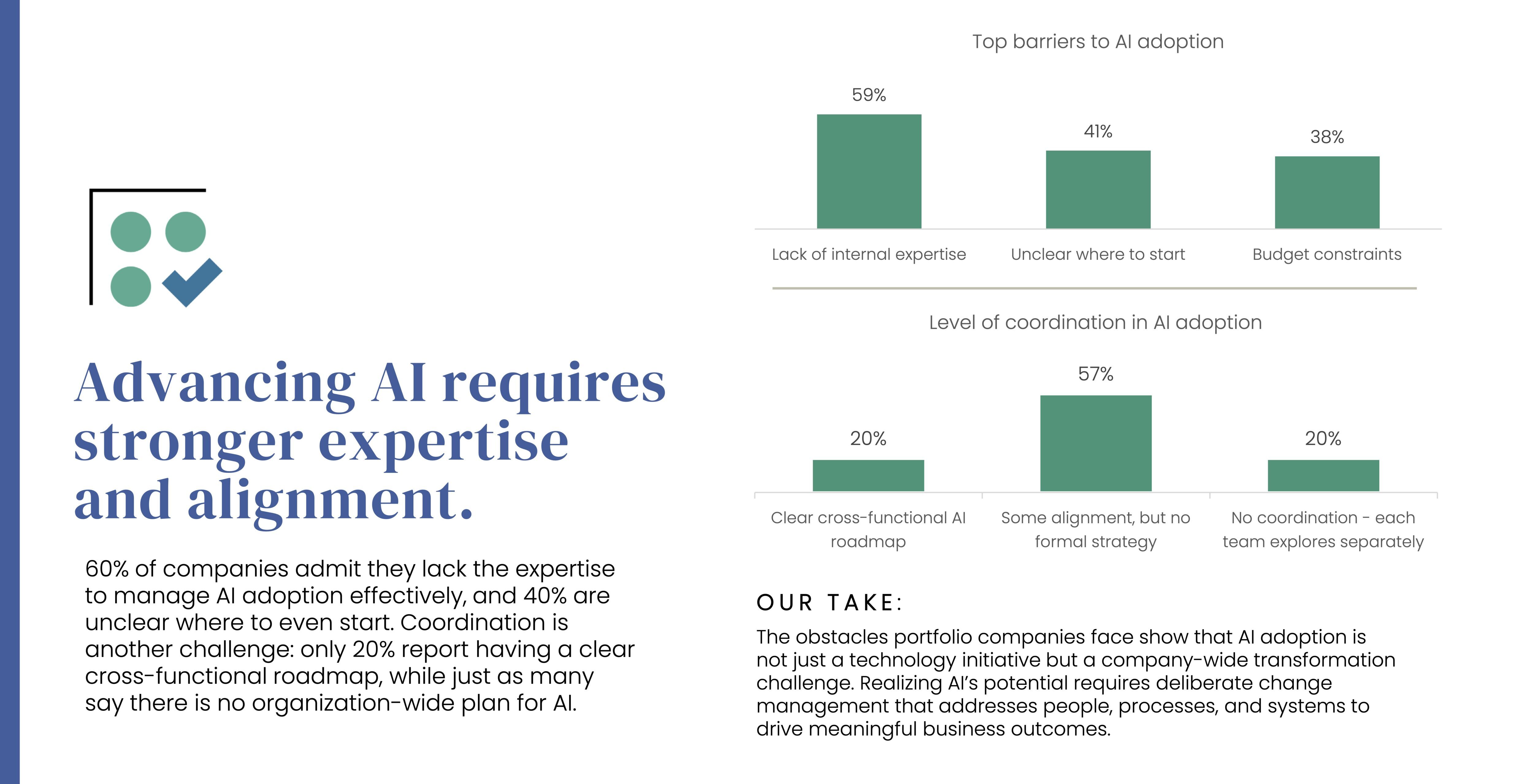
Still, we believe that realizing AI’s full potential to improve business outcomes requires intentional change management that addresses people, processes, and systems.
Top AI Concerns (And the Reality of Job Evolution)
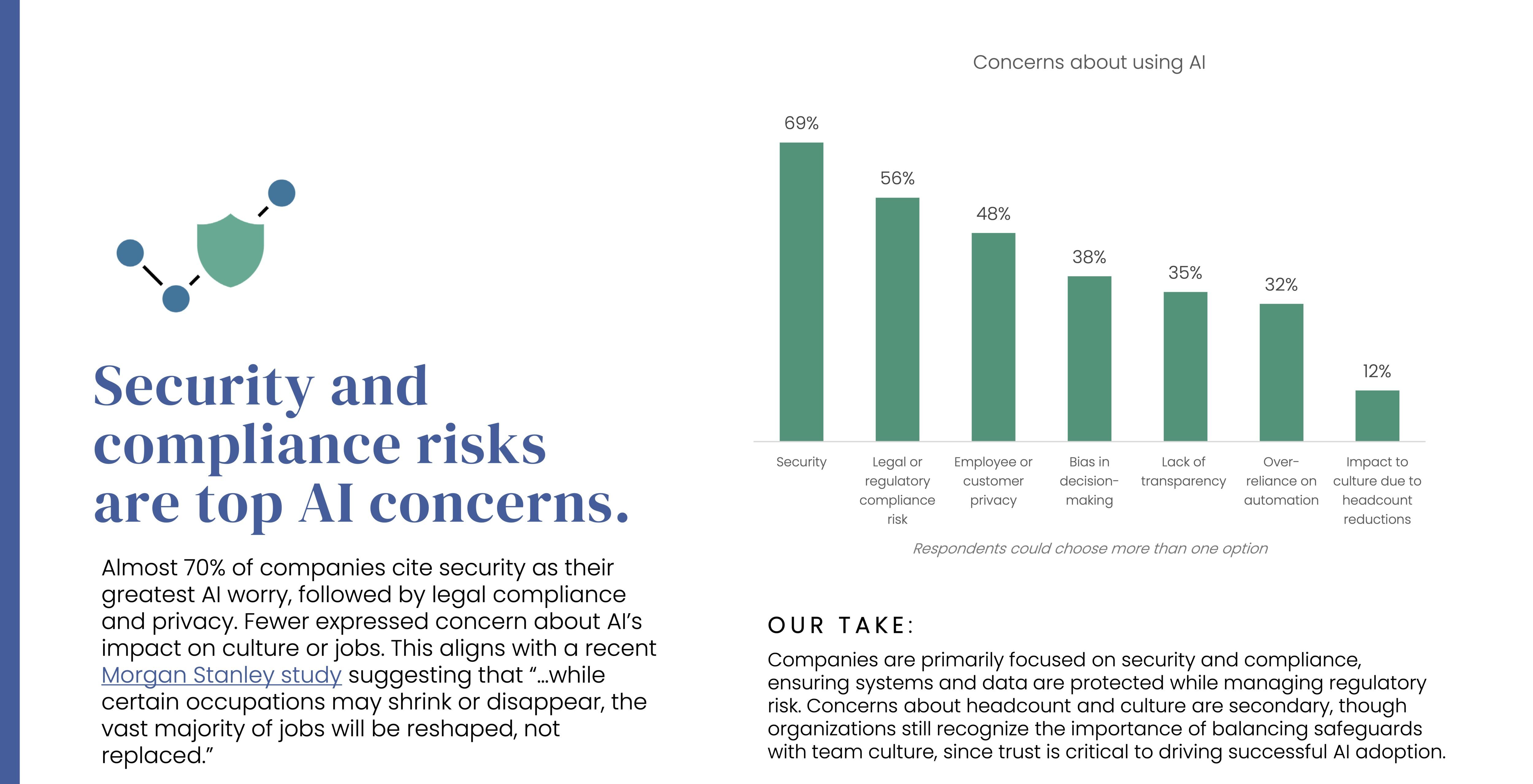
Let’s just say it: yes, AI is changing jobs. But it’s more complicated than “robots are taking over.” We asked our companies about their concerns about using AI, and interestingly, headcount and culture were secondary to security and compliance.
Companies are first and foremost concerned with ensuring systems and data are protected while managing regulatory risk.
At the same time, organizations recognize the importance of balancing safeguards with fostering a culture of innovation, since a willingness to experiment without fear of censure (trust) is critical to driving successful AI adoption.
The research lines up with what we’re seeing at our portfolio companies: most jobs are getting reshaped, not replaced. Some roles will shrink or go away. Entry-level positions that revolve around research and repetitive tasks are the most at risk.
The companies handling this well aren’t sugarcoating. They’re straight with people about what’s changing. They’re investing in teaching existing employees new skills. They’re creating paths for people to do higher-level work. And they’re asking the hard question before every new hire: is this a role we should create/replace, or is this an opportunity to implement an AI solution?
Flexibility as Competitive Advantage (While Others Pull Back)
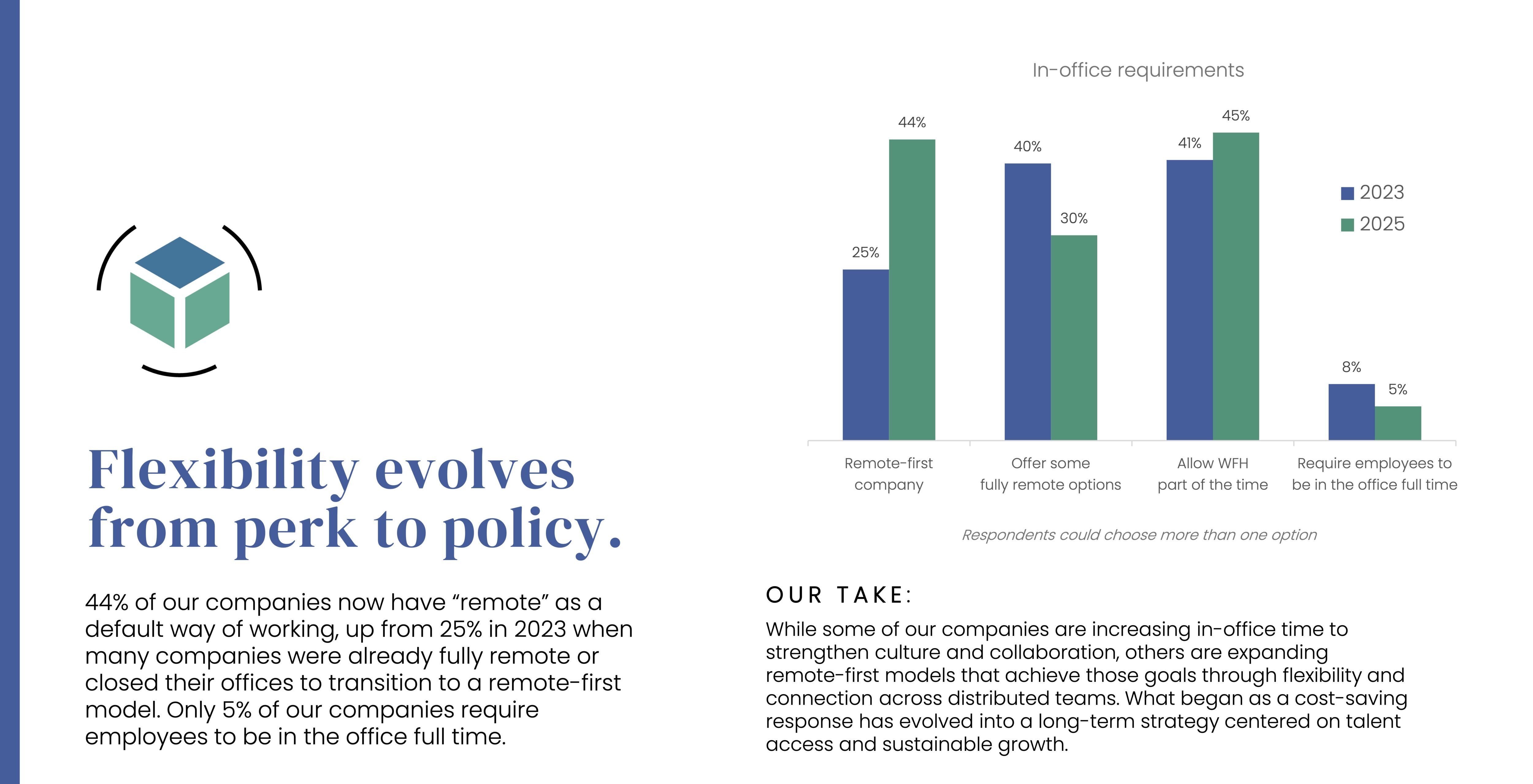
Our portfolio companies are bucking the broader trend when it comes to spending time in the office. While research shows most U.S. companies are pulling people back to the office — returning to something closer to pre-COVID norms — don’t see that trend reflected among Norwest portfolio companies.
Only 5% of our companies now require people in the office full-time. That’s down from where we were in 2023, and the number offering fully remote work has jumped 25%. The most popular setup is two to three days in the office, with three days being just as common as two.
We suspect there are a couple of factors driving this trend in the portfolio.
First, cost savings. In a challenging macro environment, startups don’t want to burn cash on expensive office leases for space that sits empty. Remote and hybrid models let companies put dollars toward growth instead of real estate.
Second, flexibility gives an edge to recruiting the best talent. When you’re a startup competing against large tech firms for talent, you need every advantage you can get. And right now, many big tech companies aren’t flexible, mandating returns to office, while startups can offer the ability to work where and how they’re most productive.
Mental Health Moves from Benefit to Imperative
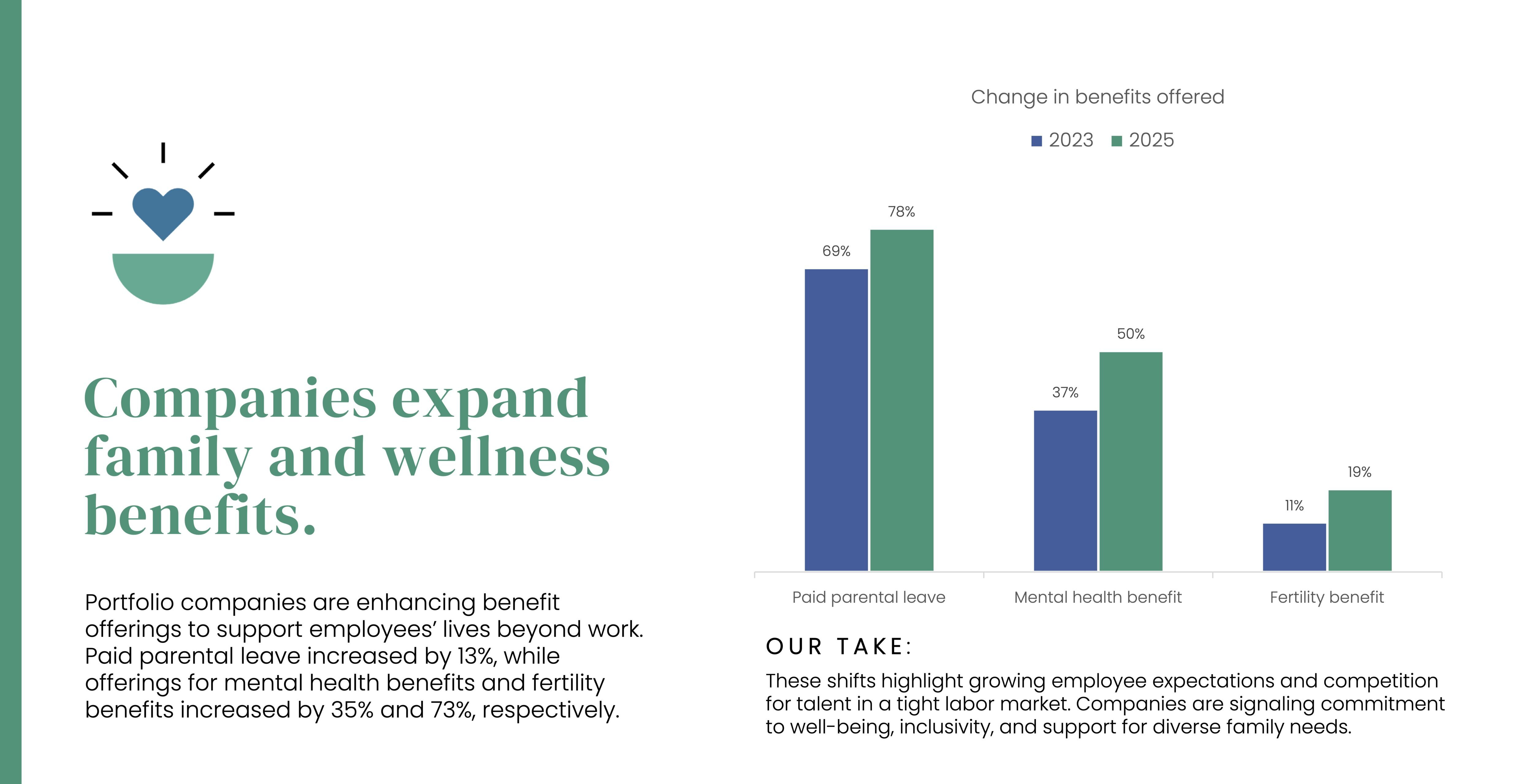
If there’s one trend that consistently keeps going up and to the right, it’s mental health support. Companies are enhancing benefit offerings to support employees’ lives beyond work. Since 2022, we’ve seen a 60% increase in companies offering mental health benefits or therapy platforms.
“Since 2022, we’ve seen a 60% jump in companies offering mental health benefits or therapy platforms.”
In a society increasingly open about mental health challenges, companies are finding it imperative to provide better support. These shifts highlight growing employee expectations and competition for talent in a tight labor market. Companies are signaling a commitment to well-being, inclusivity, and support for diverse family needs.
Our company leaders are clear that the pandemic changed employee expectations permanently – they want employers who see them as a whole person.
Inclusive Benefits: Beyond the Standard Eleven Weeks
Nearly 80% of companies offer at least 11 paid holidays, with 19% offering more than 15 holidays – this has long been table stakes for a competitive employer. But what’s more interesting is how companies think about inclusivity.
Companies are recognizing Juneteenth, Diwali, Lunar New Year, and other cultural holidays that matter to their teams. People notice when their employer appreciates what’s important to them – more acknowledgement of the “whole person”.
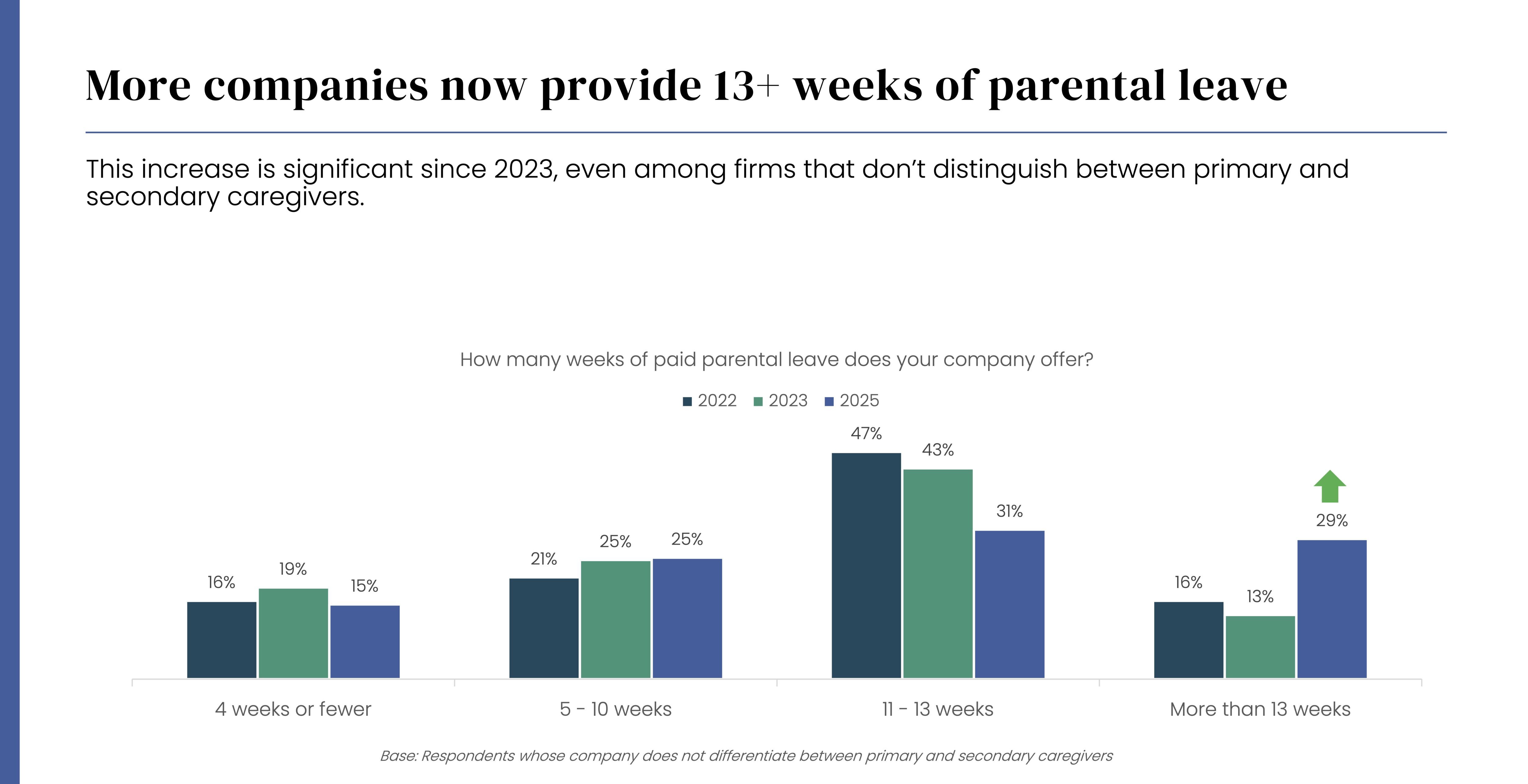
Parental leave tells a similar story. More companies now give primary caregivers 13+ weeks, up from previous surveys. Secondary caregivers typically get 5+ weeks. More companies are dropping the “primary” and “secondary” labels entirely, offering 11-13 weeks to all new parents, regardless of gender or birthing status.
What This Means for 2025 and Beyond
Looking at all this data, a few patterns jump out.
First, all those people-first strategies from the pandemic — flexibility, mental health support, inclusive benefits — they’re baseline expectations now. The bar for being a good place to work is permanently higher.
“All those people-first strategies from the pandemic — flexibility, mental health support, inclusive benefits — they’re baseline expectations now. The bar for being a good place to work is permanently higher.”
Second, the companies doing well right now start with the business problem. They ask what they’re solving before jumping to AI tools.
Third, the data from this survey shows that transformation is already happening — messily, unevenly, sometimes chaotically. Teams are experimenting with AI whether you’ve blessed it or not. People are worried about their jobs whether you’re talking about it or not. Your competitors are using flexibility as an edge whether you’ve decided on your office policy or not.
Ultimately, the gap to scaling AI adoption is not ambition or the technology itself, it’s human capital. The companies we see that are effectively managing this transition are treating this as a people challenge that happens to involve technology, not the other way around.
Special thanks to Laurie Buckingham Thomas, Teri McFadden, Kris Snodgrass, and Julia Lewis for their contributions to this survey and analysis.
For the full 2025 Norwest People & Talent Benchmark Survey results.