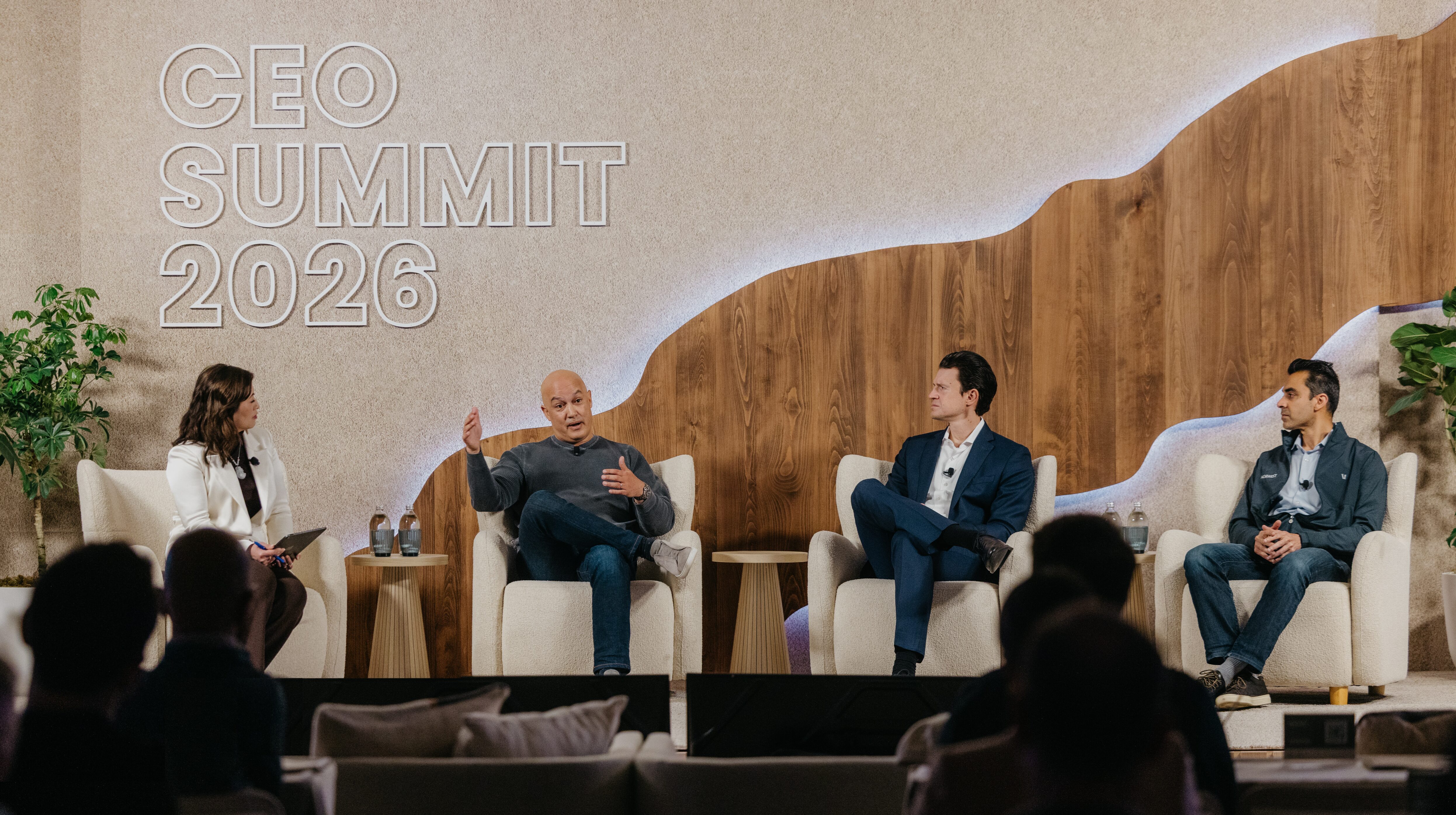
Three leaders with front-row seats to AI’s evolution sat down at Norwest’s CEO Summit to answer the question every executive in the room was already wrestling with: what do you actually need to decide, right now, to stay ahead?
Moderated by Hope King, Founder of Macro Talk News and Axios Events Host, the panel brought together Colin Evans, who leads Startups & VC Partnerships and GTM at OpenAI; Neil Hoyne, Chief Strategist at Google; and Saurabh Sharma, Chief Product Officer at You.com, a Norwest portfolio company. What emerged was a clear wake-up call. In this market, the willingness to move matters more than model selection.
Norwest convened this conversation as part of its CEO Summit, bringing together portfolio company leaders to discuss the decisions shaping their businesses. This year, AI dominated the agenda. Worldwide spending on AI is forecast to total $2.52 trillion in 2026, as many enterprises shift to ROI-driven deployment. How do you move fast enough, build the right foundations, and lead your organization through a period of change that shows no signs of slowing down?
Key Takeaways
- CEOs must choose between centralized and federated AI strategies, and set the appetite for risk. A centralized strategy allows companies to move with speed and have clarity at the top, but less input from other team members. A federated strategy will feel more chaotic, but enables exploration at all levels of the company – which is why CEOs have to set the agenda on risk appetite.
- The AI capabilities gap is widening fast. Build for where the models will be, not where they are today. Tools and models are now far more capable than what most builders are using them for. This “capabilities overhang” is only growing and the rest of 2026 will see that be extended further.
- AI strategy should follow business strategy, not the other way around. CEOs who lead with “what is our AI strategy?” are already asking the wrong question. In the next few years, many companies will be using similar AI tools and models, but leadership and strategy are what will differentiate the company.
- Culture and organizational design are the real differentiators. The companies pulling ahead empower cross-functional teams to experiment with AI and create incentives for people to share what they’re building. This brings insights out of silos, especially when leaders recognize innovation internally and reward it.
- Robust evaluations may be the new competitive moat. Model-agnostic companies that build proprietary evaluation frameworks can optimize for any model, and never get locked in. Define what “good” looks like for your specific use cases, then test every model against that standard.
- Plant the seeds across the org, and let the flowers bloom. The companies winning at AI are running incremental improvements and skunkworks-style bets in parallel, giving both the room and protection to succeed. As our panelists called it, the “controlled chaos” approach.
Controlled Chaos: A New Organizational Imperative and Cultural Differentiator
Saurabh Sharma introduced the idea of controlled chaos as the organizational model best suited for this moment. The companies winning at AI right now have set clear strategic guardrails and then deliberately let experimentation bloom within them, with different teams, priorities, and hypotheses all running in parallel and feeding back into the product.
“A lot of the job of leadership is to enable and understand that they’re entering a period of controlled chaos — where they want to set the right safeguards, the right strategy, the right optimization function, but then allow folks internally to experiment within that envelope.” — Saurabh Sharma, Chief Product Officer, You.com
The goal, as Saurabh put it, is to let flowers bloom within the organization and then build around what grows. It’s equally important for leaders to incentivize sharing learnings across peers and organizations. When people believe that using AI efficiently could eliminate roles or double their workload, they hold back. They do not share productivity gains or experiment openly. This tension explains why many companies report slower adoption than expected despite strong individual usage.
People engage more when they see AI as a way to extend their impact rather than reduce their value. The language that leaders use to encourage adoption plays a critical role in how teams respond.
We Are at a Fork in the Road
Colin Evans has spent nearly two decades as an investor and built three companies of his own, and he sees a split happening. On one side are founders building natively with the latest tools. On the other, there are those still figuring out where to start.
“For the first time ever, I actually see a divide in the road. On one side are founders and builders who know how to build with AI. On the other side, you have founders that don’t know how to apply AI or just haven’t done anything.” — Colin Evans, Startups & VC Partnerships, GTM, OpenAI
Colin pointed to what he called a capabilities overhang. Tools and models have already surpassed the pace at which most founders are using them, creating a divide between founders who stay at the frontier and those who fall behind.
Map AI Strategy to Your Business Strategy
Many visionary CEOs who understand their space, their customers, and their product feel like they’re losing control over their business. Often, it’s because they don’t have the technical background and they’ve let the pace of AI shape how they see their own authority.
Ultimately, every decision a CEO makes needs to come back to the business strategy. Neil Hoyne works with some of the world’s leading brands on leveraging data effectively and says the key is having confidence in taking action, especially in choosing partners that accelerate a CEOs vision instead of letting AI dictate the strategy.
“Come to every single vendor and technology player and say, this is the direction I’m headed. How does AI help me get there better, faster, and cheaper?” — Neil Hoyne, Chief Strategist, Google
Leadership will be the biggest differentiator for so many of the defining companies of the future. And for the organizations that are trying to mitigate all risks before moving, the panelists encouraged urgency to act instead of standing still. CEOs know their customers and their business strategy better than anyone, so their confidence in moving forward, even within ambiguity, is what will lead their companies to success.
Evaluations as Moats
For founders asking how to avoid getting locked into any one model provider, Colin Evans pointed to proprietary evaluation frameworks. His advice is to build robust evaluation frameworks across every product surface, and benchmark all new models against those evaluations.
Every company needs to understand what good looks like for its specific use cases. Once that’s defined and measured, every new model release becomes an opportunity rather than a disruption.
As long as evals are proprietary, companies will be able to identify and adopt whichever model best serves their customers. That’s the durable advantage organizations need, especially in a market where model capabilities are improving every quarter. Having that foundation in place is one of the most confident positions a company can be in.
The Road Ahead
The playing field is more open than it has been in years. Parts of every organization are already eager to work this way, already thinking about the business through an AI-native lens. The job of leadership is to find those people, give them room to run, and build around what they discover.
The decisions CEOs make right now, about strategy, culture, talent, and how they adopt AI across their organizations, are what will define the companies that thrive in the next era of work. Furthermore, the executives pulling ahead have stayed close to the frontier, made the terms of AI adoption clear to everyone inside their organizations, and had the confidence to move before every question was answered. The tools are there. The understanding is there. The only thing left to do is move.
Editor’s Note: The Norwest team thanks our panelists, Saurabh Sharma, Colin Evans, and Neil Hoyne for sharing their insights at the CEO Summit, and Hope King for guiding the conversation as moderator.