


At Norwest, we’re thrilled to announce our investment in Frontline Wildfire Defense, the company pioneering automated wildfire protection for homes and communities nationwide.
Investing, like developing new technology, often feels like a quest for the next big thing, a search for a groundbreaking solution before anyone else finds it. But sometimes, the most compelling opportunity is hiding in plain sight. The story of Frontline, both our partnership and the technology itself, which was recognized as a TIME’s Best Inventions of 2025, is one of those.
In January 2025, devastating wildfires tore through Los Angeles, claiming over 16,000 structures and causing over $40 billion in insurance industry loss. The overwhelming scale of the fires was unprecedented. “Los Angeles County and all 29 fire departments in our county are not prepared for this kind of widespread disaster,” said LA County Fire Chief Anthony Marrone in a January 8 press conference.
But amid all that destruction, something remarkable happened. 59 homes survived the devastation, protected by a novel system called Frontline Wildfire Defense. This success caught our attention and validated what we believe is a fundamentally different approach to protecting people and property from wildfires.
Months before the LA Fires, Norwest Vice President Cassie McHenry was researching climate technology when she discovered Frontline. Cassie quickly identified the value to Frontline’s approach of protecting homes in harmony with the natural environment, and was soon talking with Harry Statter, Frontline’s founder and CEO.
Great investments start with great founders, and Harry embodies everything we look for in founders we want to partner with. “Harry is phenomenal, a top-tier entrepreneur who’d devoted his life to solving this problem,” Cassie recalled. As a landscape ecologist with decades of wildfire expertise, he spent years managing forests before realizing that prevention alone wasn’t enough, we needed automated defense, too.
What started as a single conversation turned into months of relationship building. We flew to Jackson, Wyoming, shared meals, went hiking and cliff jumping in the Tetons, and got to know Harry’s vision for defensible living: enabling property owners and communities to take a proactive approach to living in a world where wildfires are increasing in prevalence and severity.
In 2025, the LA Fires alone are estimated to have caused north of $250 billion in damage, with insurance losses growing exponentially. Nearly 48 million buildings, equivalent to about one-third of all U.S. structures, are located in counties with high wildfire risk. Up to 90% of structure ignitions come from windborne embers. Traditional firefighting simply can’t scale when hurricane-force winds scatter embers up to 24 miles from fire perimeters.
“Up to 90% of structure ignitions come from windborne embers. Traditional firefighting simply can’t scale when hurricane-force winds scatter embers up to 24 miles from fire perimeters.”
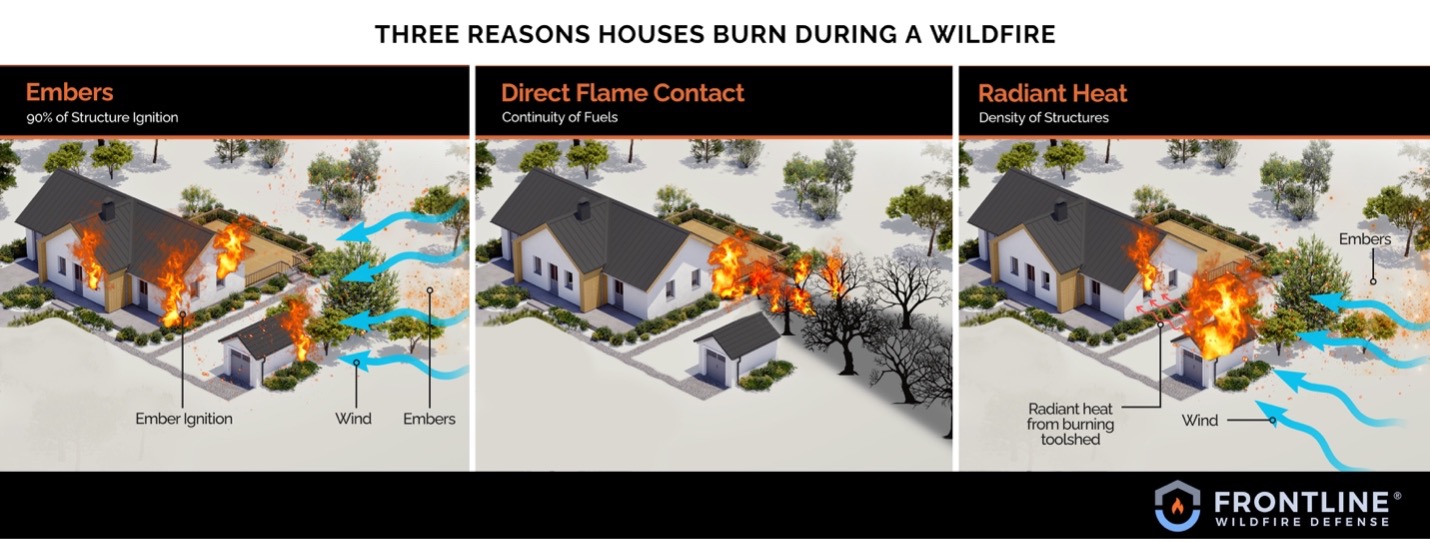
As Harry put it: “You have to automate protection, because you’re never going to have enough boots on the ground to defend all the structures that are simultaneously exposed.” We saw this play out in Los Angeles.
The city of Los Angeles has one of the most capable firefighting services of anywhere in the world; when the fires hit in January, the city deployed over 7,500 personnel, including more than 5,000 firefighters and 1,200 engines from mutual aid, plus crews from Oregon, Washington, New Mexico, Utah, and Idaho. It was still not enough.
The Science of Survival: Why Frontline Works
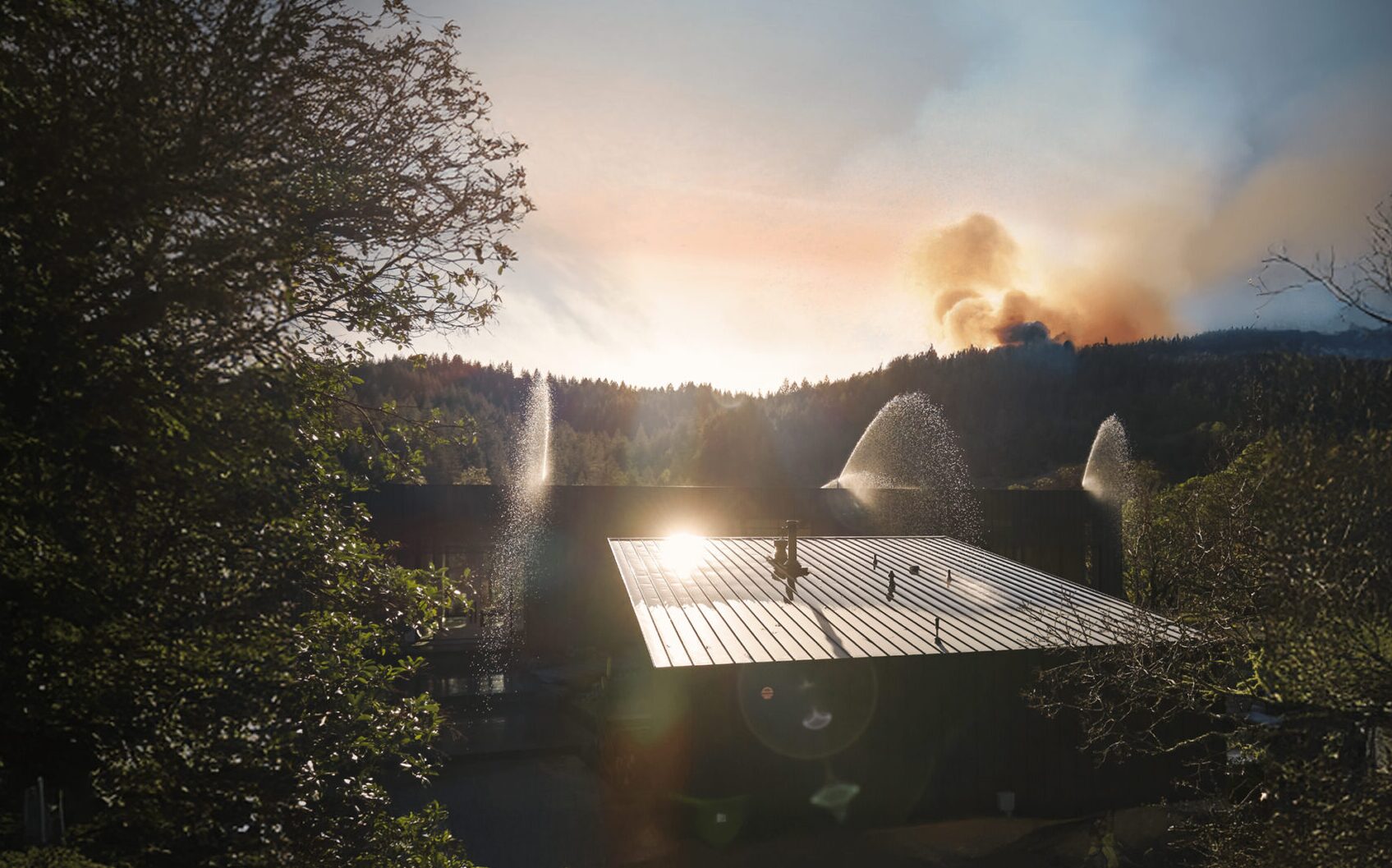
Frontline’s approach is grounded in the science of longstanding structure protection from fire. Instead of directly fighting the fire, Frontline prevents ignition from happening. The system does exactly what a firefighter would do with days to prepare: create an environment that’s too wet to burn by pre-wetting the structure and its surroundings.
“The system does exactly what a firefighter would do with days to prepare: create an environment that’s too wet to burn by pre-wetting the structure.”
Frontline’s technology is the most advanced and comprehensive wildfire defense solution available for protecting any structure. Architecturally incorporated roof-mounted and eave-mounted sprinklers use the same biodegradable foam that firefighters use, along with water, to saturate properties before embers arrive. The mixture of water and foam is delivered via a proprietary water algorithm that expertly saturates on and around the structure where embers might ignite. Since a majority of structure ignitions come from windborne embers rather than direct flames, this targeted approach is incredibly effective at stopping fire before it can take hold.
Frontline’s system is the first in its class to combine design, hardware, and software, specifically engineered to protect against ember ignition. The software continuously monitors all fires across the US, pulling data from satellites, cameras, sensors, and weather stations. When it detects the conditions that could threaten the structure, the system activates automatically, whether you’re at home or already evacuating. Multiple backup systems ensure it continues running even when power fails, water pressure drops, or cell towers go down.
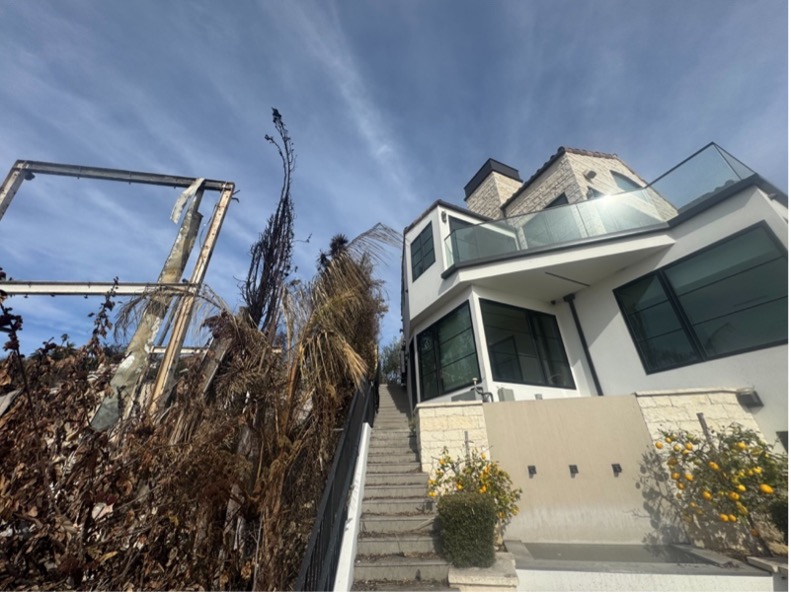
The 2025 Los Angeles fires were a powerful proof-point for the efficacy of Frontline’s approach. For the homes protected by Frontline, the results were life changing. Deck fires stopped at the wetted perimeter of the home, flames climbing stairs halted at the protected zone, and in one devastated neighborhood, a Frontline-protected home stood as the last one on its block.
Climate Adaptation: Building Solutions for a New Reality
We’re in the early innings of climate adaptation investing. Many businesses and homeowners are seeking solutions that proactively protect their livelihoods from wildfires, flooding, and other severe elements of climate change.
Frontline is at the forefront of this approach. Instead of trying to prevent wildfires, the team built technology that helps communities coexist with fire and create defensible spaces to live.
This also comes at a time when insurance losses from wildfires are growing exponentially. The current system is broken: major carriers have pulled out of fire-prone areas entirely, and where coverage exists, adaptive infrastructure is increasingly required for basic insurability.
“The current system is broken: major insurance carriers have pulled out of fire-prone areas entirely, and where coverage exists, adaptive infrastructure is increasingly required for basic insurability.”
Solving this problem will require cooperation between government, regulatory agencies, builders, insurance providers and technologists. We’re seeing early proof points as insurers begin mandating advanced fire protection systems for certain high-risk policies, and builders are discovering that incorporating these technologies can reduce insurance premiums so substantially that it makes entire projects economically viable. The regulatory environment is shifting to support these solutions, too. Building codes are being rewritten. Congress is considering the bipartisan FIREWALL Act, providing up to $25,000 in tax credits for wildfire hardening measures, explicitly including exterior sprinklers.
This represents a fundamental transition from reactive firefighting to proactive protection; exactly what our changing climate demands.
The Norwest Advantage: Doing Well by Doing Good
Frontline sits at the intersection of markets we know intimately: essential residential services, insurance technology, data platforms, safety technology, and recurring software. Our portfolio includes companies like GoFundMe, which played a crucial role in Los Angeles wildfire recovery, and Avetta, focused on worker safety across many dangerous end markets.
The common thread throughout these investments is the genuine value they create while addressing real-world problems. We call it doing well by doing good. All Norwest investments emphasize our values of choosing long-term rewards over short-term gains, yielding the best results for everyone.
As Frontline scales from thousands to tens of thousands of installations, it will benefit from what our team brings, including infrastructure to support hypergrowth, strategic guidance through regulatory landscapes, and deep relationships across insurance and financial services.
Looking Forward: Building Resilient Communities
The Los Angeles wildfires put a national spotlight on wildfires. For some, it fundamentally changed how they think about wildfire risk.
Frontline represents something bigger than home protection; it’s a new way of thinking about living with natural disasters. Instead of trying to control nature, we’re learning to coexist with it intelligently.
The company’s vision extends beyond individual homes to community-wide protection systems and neighborhood-level resilience. The rebuild in Los Angeles offers an immediate test case. An estimated 16,000 homes and structures were lost in the fires. But the long-term opportunity spans millions of at-risk structures nationwide, as wildfire risk continues to grow.
Climate change isn’t a future problem. It’s happening now. Frontline has the kind of forward-thinking, technology-driven solution that helps communities live safely alongside the effects of extreme climate events.
We believe Frontline is positioned to define an entire category of wildfire defense technologies. Its success will prove that private markets can deliver meaningful solutions to our most pressing environmental problems.
“We believe Frontline is positioned to define an entire category of wildfire defense technologies. We’re excited to help the company bring this technology to communities that need it most.”
At Norwest, we’re drawn to companies that tackle important problems while building enduring businesses. Frontline does both: protecting families’ most valuable assets while creating pathways to safer, more resilient communities.
The Los Angeles wildfires are a proof-point of the new normal our communities face. Frontline shows us what’s possible when innovation meets determination. We’re excited to help Frontline bring this technology to communities that need it most.