

For over two decades, B2B marketers have done a never-ending dance to reverse-engineer Google’s algorithm. Brand-owned content drove brand awareness around key thought-leadership topics, and the links Google surfaced had been the front-door for product research. In 2026, AI is changing enterprise buyer behavior drastically, and GTM teams have to redefine everything – from org design and campaign orchestration to thought leadership and content.
To help our portfolio leaders refine their playbooks, Renée Cohen, Norwest Principal and Marketing Operating Executive, and Gail Moody-Byrd, Norwest Senior Advisor for GTM, Marketing and Category Creation, hosted a webinar exploring how today’s highest-performing B2B companies are building what Gail calls a “trust architecture.” The approach is a deliberate network of trusted voices that strengthens visibility, builds credibility, and ultimately drives pipeline.
Brands Now Must Influence the AI Answer Engines, and the Humans Who Trust Them
Regardless of industry or growth stage, marketers are running into the same challenges:
- Organic traffic is declining.
- Paid search is not delivering the same returns.
- Buyers seem to form opinions long before they reach a live salesperson or the company website.
Generative AI has become the starting point for most B2B buyers. According to Forrester, for those who still habitually head to Google search, 82% of B2B technology queries yield an AI overview. Marketers are losing control over the words used to describe their brand, because — as it turns out — AI listens to your company less than it does to other sources. A large majority of what LLMs cite is earned media rather than brand-owned content.
As the power shifts from publishers to the synthesizers, we B2B marketers have a new challenge: to shape the signals AI learns from. Influencing AI is going to require an integrated strategy of brand marketing in lockstep with thought-leadership credibility and content. The most durable way to dominate the LLM “mindshare” is to build a network of trusted influencers who speak your name when you’re not in the room.
“And when 85% of B2B buyers purchase from vendors they have shortlisted before ever speaking with sales, the trust architecture is important not just for “winning” AEO. Trust architecture creates the brand visibility, credibility and consistent positioning needed to become “preferred,” which impacts pipeline creation and win rates.”
B2B Influencer Marketing: The Trust Architecture to Drive Discoverability at Every Stage
In the past, we’ve treated work such as messaging, content, AR/PR, and SEO as distinct disciplines. In today’s information economy, such functional areas cannot be siloed. They are critical components of a trust architecture that operates on multiple levels, activating the voices of:
- Founders/internal champions who educate and provoke dialogue
- Influencers/practitioners who are highly credible in your category
- Tier 1/2 analysts and press who validate your space
- Customers with credibility among peers
A recent LinkedIn study reinforced what many marketers already believe — that being named a top solution by analysts or experts is 1.7x more influential for buyers than brand-authored content. Top Rank Data reported that 87% of buyers give more weight to content featuring influencers they trust.
Marketers are already reflecting this strategy shift in their 2026 plans, with three-quarters of enterprise B2B companies increasing their influencer relations budgets. Even more, Gartner expects 80% of enterprise marketers to be running influencer programs by 2027.
“The best B2B CMOs that I’m meeting today are not only using influencer marketing for discoverability, but they’re actually leveraging it through conversion and measuring the impact.”
The way you build an influencer program should evolve alongside your company’s growth stage and business objectives. To help marketers map the right influencers, channels, and metrics to the desired outcomes, Gail developed the Trust Architecture 3×3 Framework.
The Trust Architecture 3×3 Framework comprises three rows, segmented by company stage (Seed/Series A, Series B/C, Growth), and three columns, segmented by objective (visibility, credibility, velocity).
Table One below maps the best-fit influencer types and platforms for each company stage to their respective objectives. An obvious caveat that bears stating here is that types and platforms will vary depending on ICP; for example, developers and CROs value very different voices and approaches.
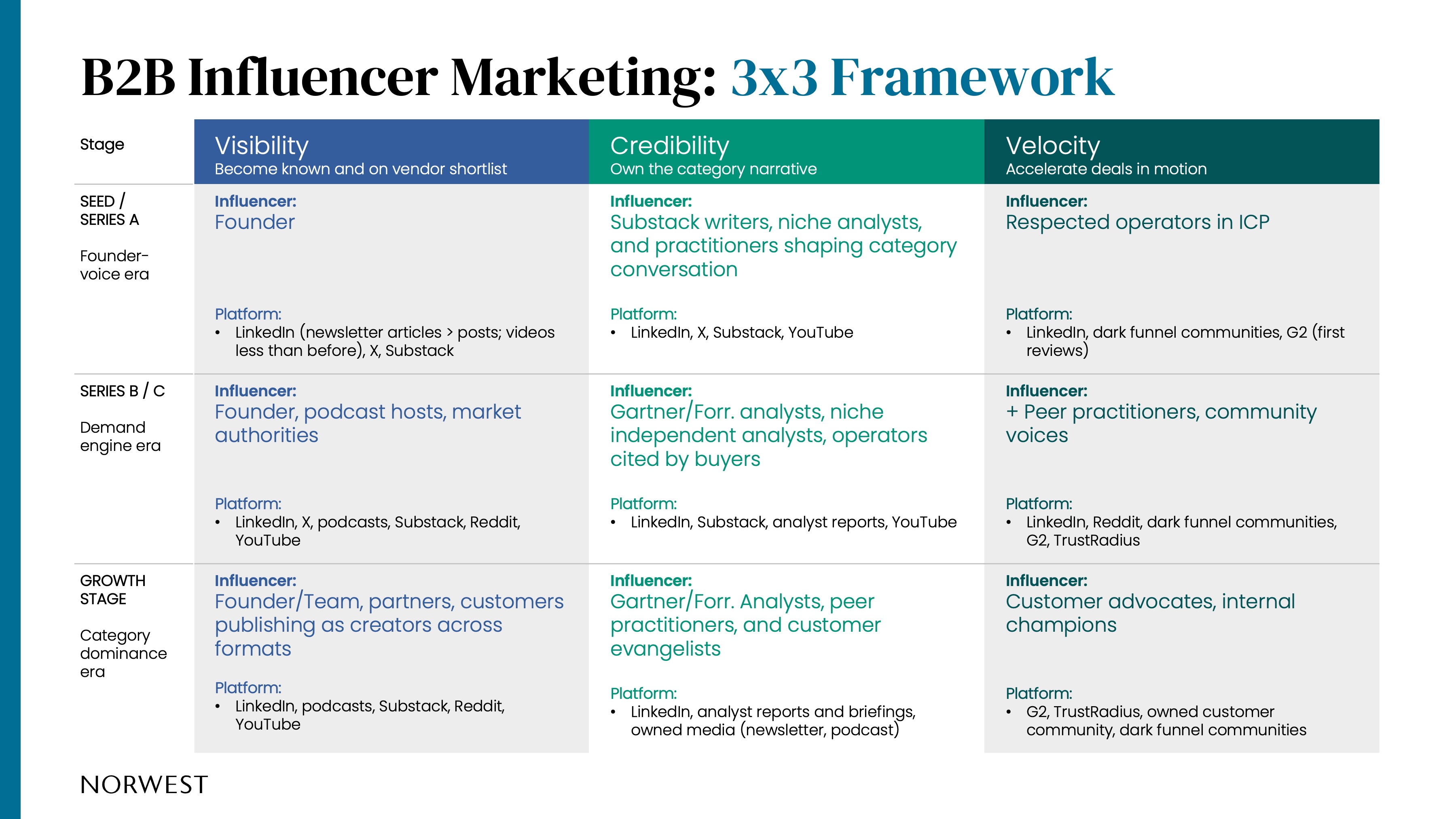
Your company’s stage and goals will impact how you get started.
- Stage
- Seed/Series A companies typically lead with the founder voice to establish visibility through channels where content, often contrarian in nature, can spark engagement, such as LinkedIn, X, or Substack.
- Series B/C companies expand from founders to other internal subject-matter experts and engage podcast hosts, market authorities, partners, and customers who publish as creators.
- Growth-stage companies are seeking category dominance and lean towards established, powerful drivers of engagement and credibility, building upon all that preceded this stage.
- Goals
- Visibility establishes awareness and helps you become known in your space and on vendor shortlists.
- Credibility shapes gradual ownership of your category narrative.
- Velocity accelerates deals in motion — the ultimate goal for go-to-market teams.
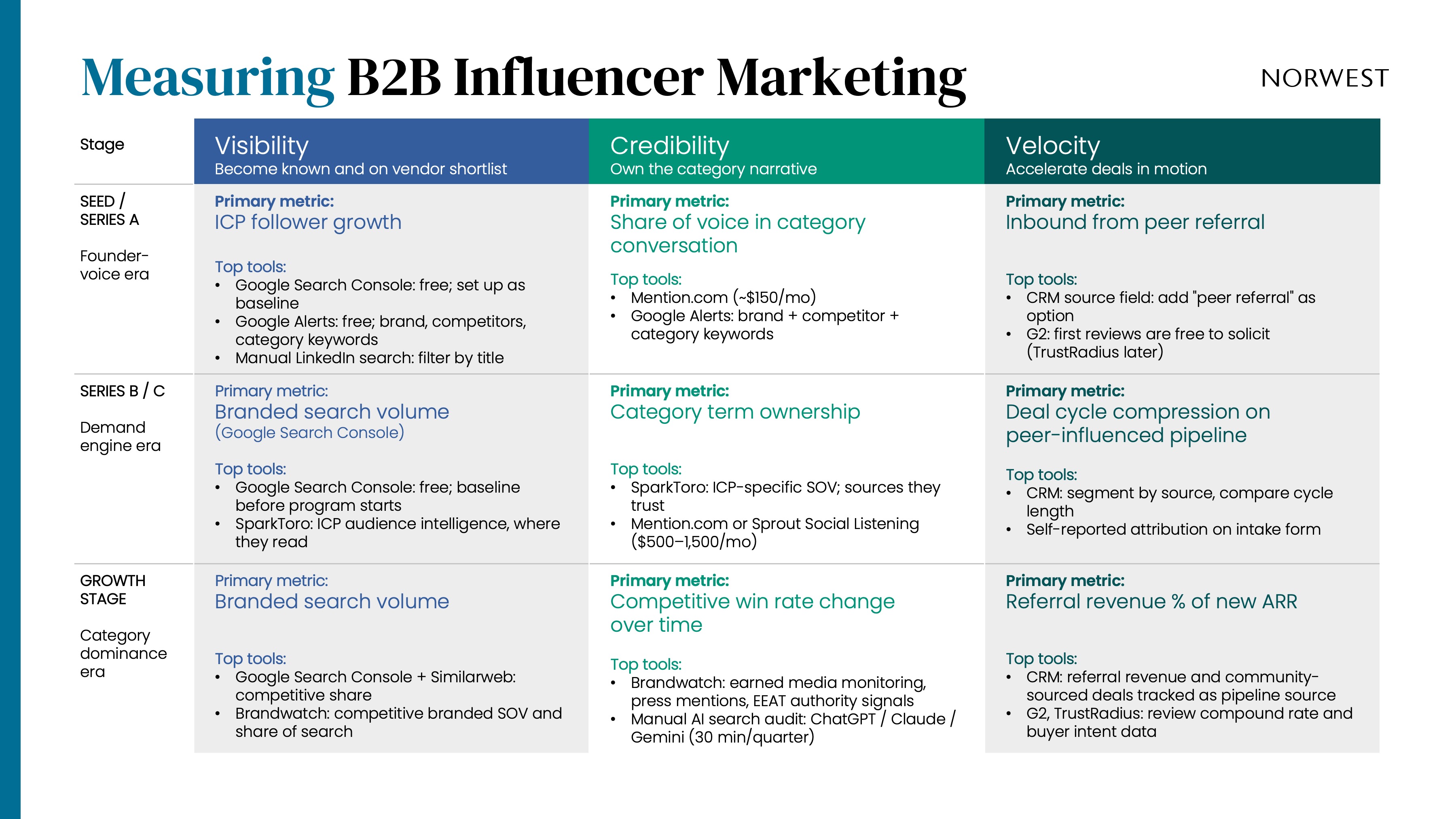
Measurement is a notoriously controversial topic when considering influencer and community marketing. Table Two uses the same rubric, this time focusing on measuring the effectiveness of the influencers and platforms suggested above, indicating the metrics most likely to matter, and tools to capture performance. This is meant to be directional and not all-inclusive.
Best of Breed Influencer Marketing Starts with an Integrated Strategy That the Trust Architecture Supports
There isn’t a one-size-fits-all playbook for influencer marketing. Every company’s mix of ICP and founders, customers, practitioners, analysts, and partners will look different. But across our portfolio, we’ve seen the value of intentionally building trusted voices around a business, particularly as a long-term go-to-market capability integrated across brand and demand gen.
Based on Gail’s experience, organizations achieving the most success with B2B influencers have programs that:
- Treat influencer marketing as infrastructure, not a campaign. The best programs run continuously with five to ten trusted voices whose audiences overlap with the brand’s ideal customer profile (ICP).
- Match influencers to specific jobs-to-be-done. Visibility, credibility, and velocity goals are best achieved by selecting the best-fit influencers at each stage, leveraging targeted syndication channels.
- Identify the voices that speak credibly for that market. Take a look at the profiles of three stellar examples we spoke about during our webinar: Gal Aga, Uri Knorovich, and Samantha McKenna, who embodied principles highlighted across the framework.
- Measure results through an amalgam of sources. For visibility, look at branded search volume and ICP follower growth. For credibility, measure share of voice and competitive win rate. For velocity, track inbound from peer referrals, referral deal cycle length, and referral revenue as a percent of ARR.
There’s more in the way between your owned-brand content and your market than there used to be. Your buyers are learning about new tech solutions from content creators, their personal networks, and whatever AI synthesizes about you – long before they visit your website or LinkedIn. Your category’s top five influencers’ Substacks (including your co-founders, if they have one) are way more influential than your generic company blog.
The infrastructure of the new enterprise marketing playbook has to include the Trust Architecture. Because your typical buyer isn’t the only one listening to the influencers – the AI Answer Engines are too.