

The term GTM Engineer has made its way into nearly every GTM conversation we’ve had with Norwest portfolio companies over the last 6 months. If you’ve seen job listings for a GTME circling around LinkedIn and thought “What the heck is that?” you’re not alone.
To demystify the role, Principal and Marketing Operating Executive Renée Cohen, Senior Advisor of Revenue Operations Mike Heilmann, and President of Sloane Staffing Max Spanier shared their perspectives on three key questions shaping go-to-market teams:
- Why does the go-to-market engineer role exist?
- What is a go-to-market engineer?
- How do you hire a go-to-market engineer?
At the core of this conversation is the undeniable truth that AI has fundamentally shifted go-to-market tactics and how companies think about scaling revenue operations.
Why Does the Go-to-Market Engineer Role Exist?
Norwest’s 2025 B2B benchmark report, which surveyed 177 B2B sales and marketing leaders, found a clear relationship between AI adoption and GTM performance.
Companies using more AI tools were more likely to report that marketing was generating most of the opportunity pipeline. Now, that’s not evidence yet of cause and effect, but there is a strong correlation that every founder and go-to-market leader should be paying attention to.
When it came to revenue, we found that the organizations that raised their revenue targets were about 3x more likely to have three or more AI use cases in production. The companies that kept their targets flat or decreased them were more likely to be in the early experimentation phase with AI. For us, these data points provided a picture that AI use was finally beyond efficiency, and could be tied to speed to market, faster execution, and the ability to create and convert opportunities with less human friction in the loop.
Hiring patterns are shifting too. Marketing operations roles grew year over year, while SDR and BDR hiring declined as companies began automating parts of outbound prospecting, account routing, and workflow management.
“Teams are naturally starting to rethink where they want to place the human capacity on their teams.”
The benchmark data also found that AI adoption in go-to-market organizations was largely happening from the bottom up. The people driving change were operators closest to the work — the ones who understood the manual processes, bottlenecks, and repeatable tasks that could be automated.
That dynamic is helping fuel demand for the go-to-market engineer role. In many ways, RevOps has become a proving ground for this function. RevOps professionals have a front-row seat to how GTM systems work, and we saw strong evidence of self-directed learning within these teams. Rather than relying on outside consultants to implement AI, companies are building capabilities internally, experimenting quickly, and learning as they go.
The data suggests that the most successful person in this role won’t parachute in with generic AI playbooks. They’ll be the people inside the organization who understand the workflows, are curious enough to learn the tools, and can build solutions tailored to their business.
Mike has made that transition in real time over the past year, which is why his perspective has been invaluable for providing a practical framework to our portfolio leaders.
What is a Go-to-Market Engineer?
At its core, a go-to-market engineer is a builder. Someone who combines a deep understanding of revenue operations with the technical skills to design, automate, and improve the systems that power go-to-market teams.
For Mike, the path into GTM engineering started with a curiosity about coding and a desire to apply those skills to real business problems. That origin story is common among many of the people gravitating toward the role today. Successful GTM engineers are operators who started playing around with automation and experimenting with tools like Clay, Zapier, Make, Claude Code, and Codex, and gradually learned how to solve workflow problems.
“The people who thrive in these roles are builders. They enjoy and are personally fueled by creating cool things that solve problems.”
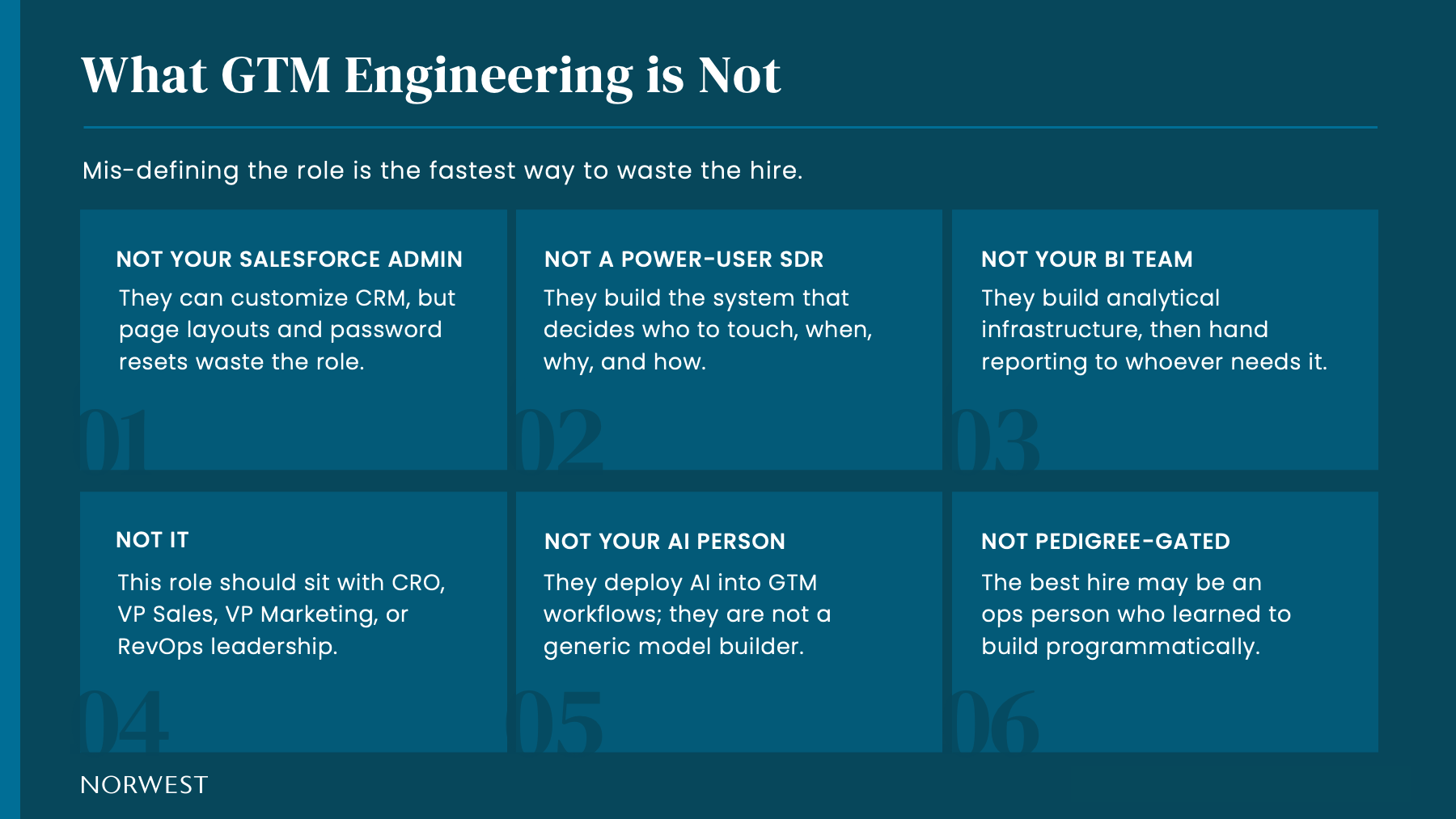
If we’re defining what a GTM engineer is, we also need to be clear about what a GTM engineer is not. Companies should avoid treating GTM engineers like generic admins, IT, or your BI team. They also can’t be your catch-all AI person because the role works best when connected to revenue problems and business workflows.
The Traditional RevOps Way vs the Modern GTM Engineering Approach
To understand why GTM engineering feels so different, it helps to compare it with the way go-to-market operations have traditionally worked.
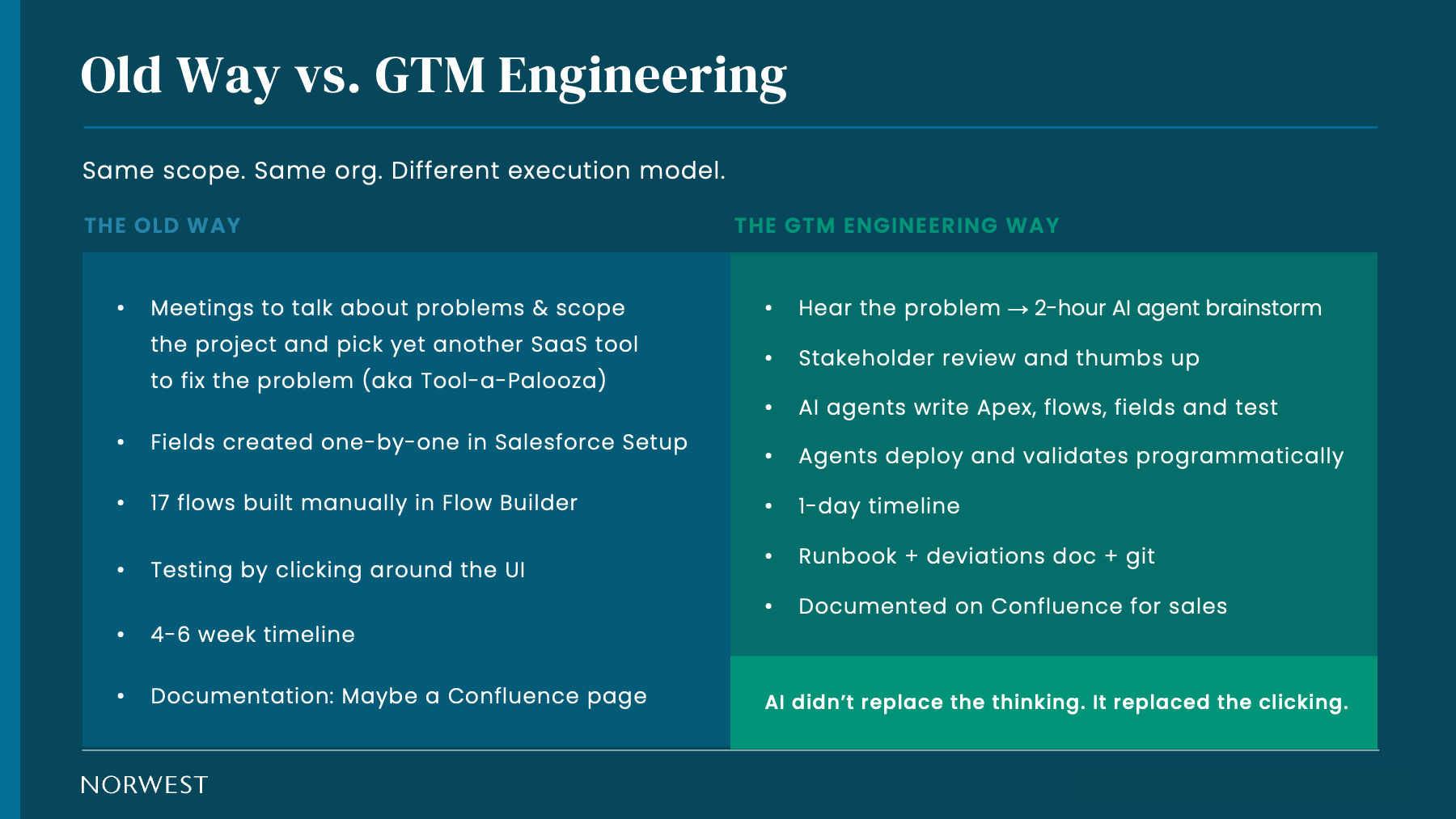
In the traditional RevOps model, execution is often scattered across admins, RevOps, MarketingOps, SDR managers, analysts, and sales leaders. When the business needs more output, the answer is usually more headcount: another admin, another ops person, another analyst, another tool. Over time, that creates what Mike refers to as “toolapalooza” — a SaaS platform for every problem, layered on top of systems that don’t always talk to each other.
The work itself is also highly manual. Fields are created one by one in Salesforce or HubSpot. Flows are built in application UIs. Documentation, if it happens at all, often comes after the fact. And because CRM customizations tend to live with one admin or developer, teams can end up building workarounds on top of workarounds without fully understanding how the underlying system works. That makes execution slow and expensive.
The GTM engineering approach changes the workflow entirely. Instead of kicking off a long cross-functional process, the GTM engineer joins the initial problem conversation, listens closely, documents the issue, and then returns with a proposed solution. From there, the work moves into a technical environment. Using AI agents, the GTM engineer can interrogate systems like Salesforce, HubSpot, Outreach, and other parts of the GTM stack to understand the relevant workflows, fields, automations, customizations, and edge cases.
Once the problem is mapped, AI can help generate a solution plan that accounts for the company’s existing CRM architecture, business requirements, and known best practices. That plan becomes the basis for stakeholder review. Instead of debating the problem across multiple meetings, stakeholders can react to a well-documented proposal that shows how the fix will work, what systems it touches, and what outcomes it is designed to support.
After approval, the GTM engineer can deploy AI agents to help build the solution: writing code, creating fields, configuring flows, testing edge cases, validating deployment, and producing documentation for both technical teams and end users. The result is not just faster execution, but a more complete and traceable process.
“I used to work in the old way. I thought that was how business was done,” Mike shared in the webinar. “Now that I’m operating in the new way, I will just tell you there is zero chance I’m going back. AI didn’t replace the thinking. I still knew what I wanted and how I wanted to go about it. It just basically replaced the clicking.”
A common question we get from leaders is whether AI-assisted execution introduces new risk. In practice, the discipline runs the other way. Traditional CRM changes were often made by hand with limited testing and little documentation. The GTM engineering workflow is built on engineering controls — changes are specified and reviewed before they’re built, validated against test cases, deployed through repeatable processes, and documented with rollback paths. The speed doesn’t come from skipping controls. It comes from bringing software discipline to work that previously had very little.
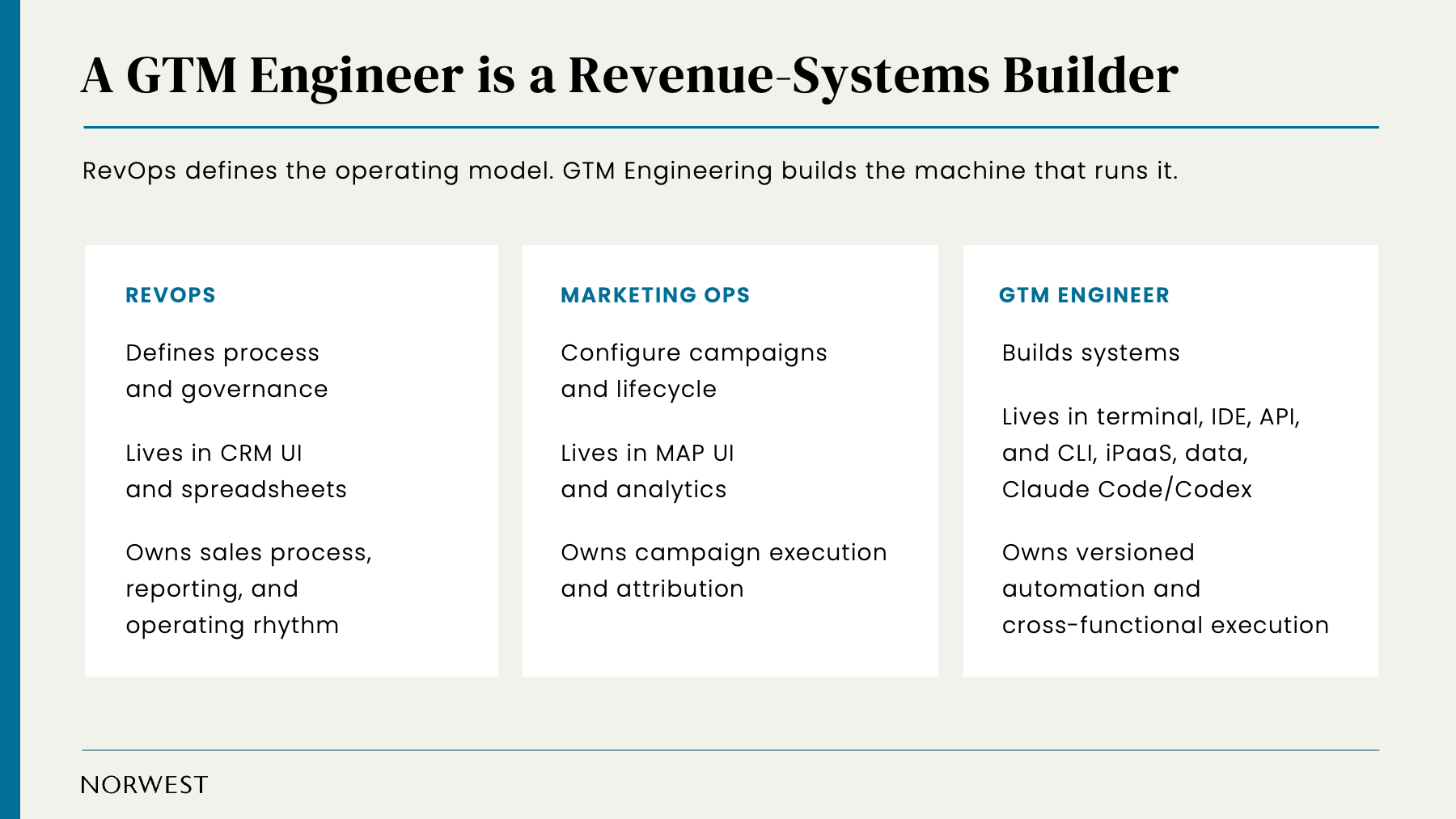
As AI becomes embedded in more go-to-market processes, we see a future where RevOps and Marketing Ops roles contract and GTM engineering roles accelerate. Rather than spending as much time executing manual workflows, Mike theorized that RevOps and Marketing Ops could become increasingly focused on business outcomes, like pipeline generation, forecasting, revenue attainment, and operational performance. GTM engineers, meanwhile, will build the systems, playbooks, and agentic workflows that help achieve those goals.
In that sense, GTM engineering isn’t replacing RevOps or MarketingOps — it’s becoming the technical execution layer that enables those functions to operate at a new level of scale and efficiency.
If that vision plays out, Mike expects GTM engineering roles to grow rapidly over the next several years as companies look for people who can bridge the gap between business operations and technical implementation.
When and How Should You Hire a Go-to-Market Engineer?
Max Spanier started his recruiting business in 2019, just as MarketingOps was becoming a distinct function and RevOps was gaining traction. Today, he works closely with companies like Clay, 6sense, and Norwest portfolio companies to hire GTM engineers. He shared his advice and what he looks for in a candidate with us.
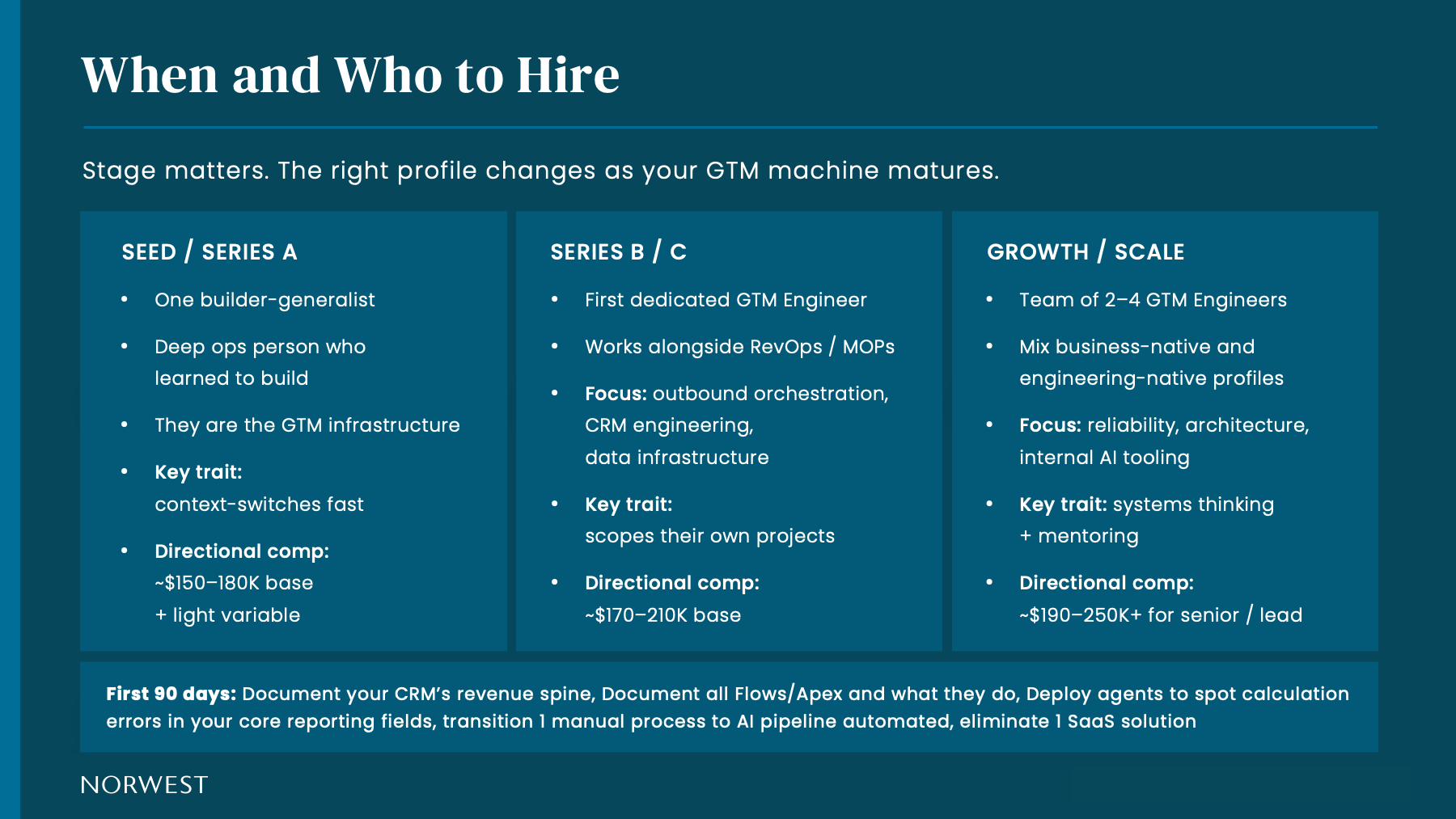
Like most emerging roles, the answer of when to hire depends on where your company is in its growth journey and what problems you’re trying to solve.
At the earliest stages, founders are often the GTM engineers by default. Before product-market fit, there may not be enough complexity or enough repeatable processes to justify a dedicated hire.
For many companies, the inflection point appears around the Series A to Series B stage. By then, there is enough scale, tooling, and operational complexity for a dedicated builder to have an outsized impact. Rather than adding more people to manage disconnected systems, companies are investing in someone who can streamline workflows, automate repetitive work, and improve how information moves across the revenue organization.
“Before you hire five more SDRs, ask whether one GTM Engineer could rebuild the machine they’re about to operate. The CRM is the system of record. The terminal is the cockpit.”
As companies continue to scale, the role often evolves from an individual contributor into a team. Later-stage organizations may employ multiple GTM engineers focused on different areas of the revenue stack, from CRM architecture and outbound infrastructure to analytics, attribution, and AI-powered workflows.
What Should You Look For?
One of the challenges with hiring GTM engineers is that there is no standard career path yet.
Many of the strongest candidates don’t come from traditional engineering backgrounds. Over the last few years, many of these professionals have taught themselves modern tooling. As Max shared from his experience recruiting GTMEs, the market has moved beyond hiring for proficiency in a specific platform.
“When we first started recruiting GTMEs, companies cared whether you had Clay experience. Now, if you know Make or Zapier, or even how to vibe code, you could pick Clay up in an afternoon.”
The best candidates tend to be people who understand how go-to-market teams operate and are willing to learn new technical skills as the landscape evolves.
What Do GTM Engineers Actually Own?
While responsibilities vary by company, GTM engineers typically focus on five areas:
- Pipeline automation and enrichment: Waterfall enrichment, lead scoring, Clay/Apollo workflows
- CRM architecture and data integrity: Salesforce / HubSpot build, deduplication, lifecycle management
- Outbound infrastructure: Sequencing, deliverability, personalization at scale
- GTM analytics and attribution: Revenue
data layer, dashboards, funnel visibility - AI-native GTM: LLM-powered research, scoring, personalization pipelines
Three Common GTM Engineer Profiles
Not every GTM engineer looks the same. In practice, companies tend to hire one of three profiles depending on their needs.
The Builder typically comes from an engineering or data background and excels at creating systems from scratch. They are strongest when a company needs to design new infrastructure, build integrations, or architect complex workflows.
The Operator often comes from RevOps or MarketingOps. They understand CRM systems, automation, and process design deeply and are particularly effective at scaling an existing go-to-market motion.
The Strategist combines technical fluency with commercial judgment. Rather than building every workflow themselves, they help prioritize opportunities, define the roadmap, and coordinate teams. This profile often becomes more valuable as organizations grow and operational complexity increases.
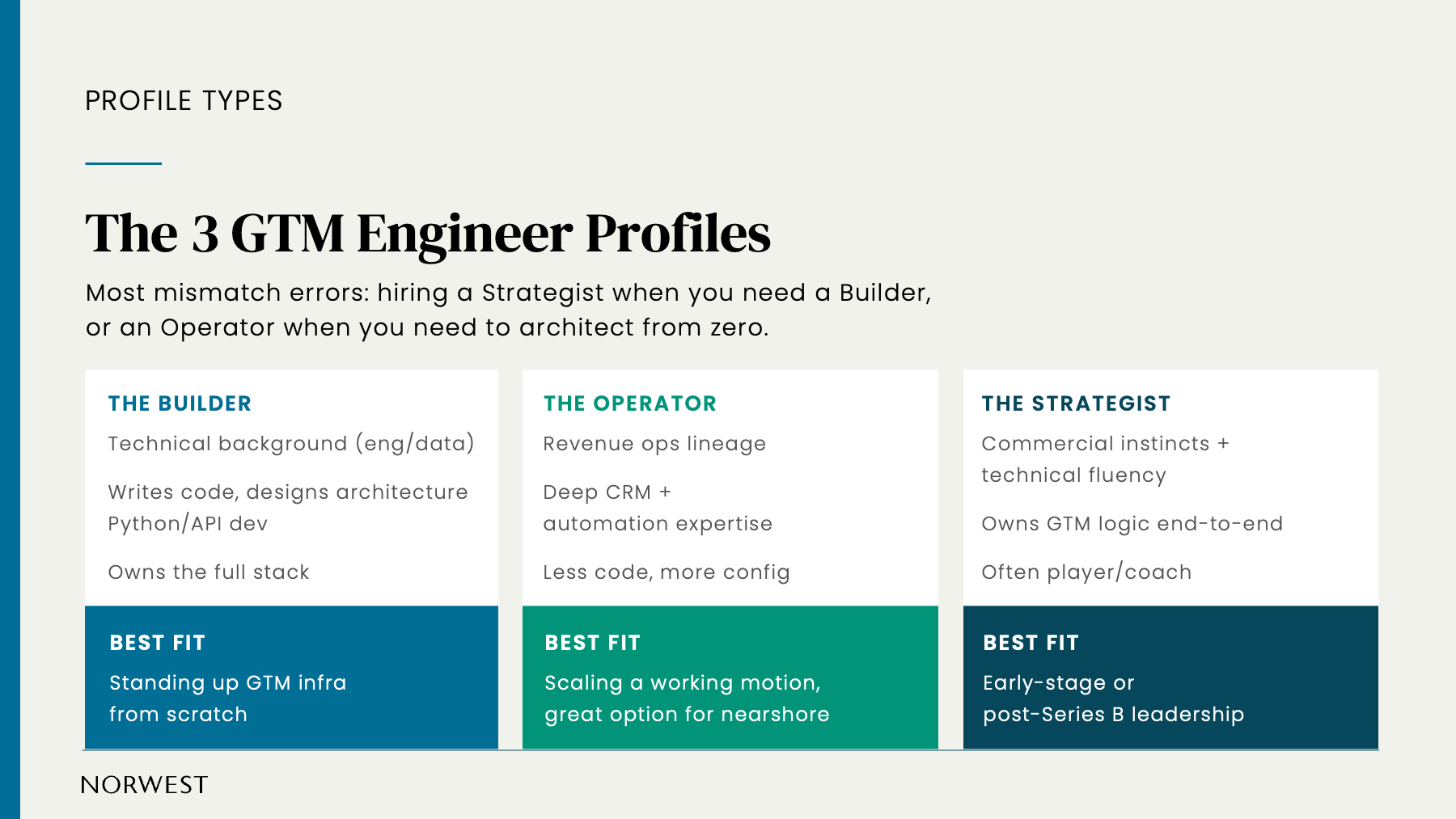
The biggest hiring mistake is often choosing the wrong profile for the company’s stage. A startup building its first revenue infrastructure may need a Builder, while a later-stage company with an established GTM engine may benefit more from a Strategist who can identify where AI and automation can create leverage across the business.
As AI takes over more of the repetitive work involved in building, maintaining, and scaling go-to-market systems, the people who create the most impact will be those who can connect business problems with technical solutions.
That doesn’t mean revenue leaders need to become software engineers. Nor does it mean AI will replace the judgment, creativity, and relationship-building that have always been at the heart of successful go-to-market organizations.
What is changing is the amount of leverage an individual can have.